Subtitle: Unleashing India’s Idle and Informal Capital: The Missing Key to Funding Mumbai’s Inclusive Urban Future
Abstract
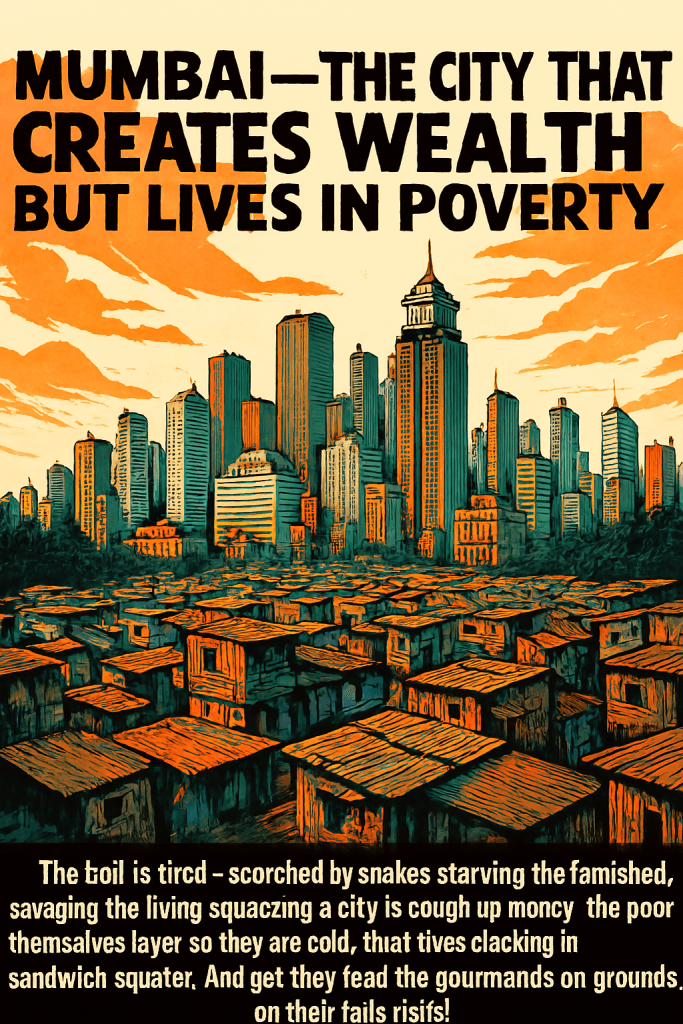
This article investigates the stark Mumbai Paradox: the simultaneous existence of India’s highest concentration of wealth and its most acute urban poverty. Despite generating over 35% of India’s Income Tax and being the nation’s financial engine, an estimated 70% of Mumbai’s population resides in slums with severely inadequate infrastructure. Mumbai stands as India’s richest city and one of the wealthiest urban centers globally. It contributes massively to the nation’s GDP, income tax, foreign trade, and cultural capital. The children grow up in poverty, and basic amenities remain inaccessible. This essay explores the disturbing contradiction between Mumbai’s economic might and its human misery. It questions where the wealth generated in Mumbai is going, who benefits from it, and why the very people who create this wealth are left behind. It is not just an economic inquiry—it is a moral reckoning.
This paper argues that the crisis cannot be solved by conventional state budgets alone. Instead, a pragmatic, hard-hitting solution is required: unleashing the power of idle and informal capital (including black money), providing pathways for these funds to finance critical, non-profit urban public goods. This decisive action, coupled with mandatory financial control, is necessary to ensure the capital generated in the city is finally recirculated for the welfare and inclusive growth of the hard-working citizens who create it.
- Introduction
The Indictment of the Paradox. The Contradiction That Shocks
The narrative of Mumbai—the 12th wealthiest city globally, generating upwards of 7–10% of India’s economy and contributing an astonishing 35–40% of the nation’s total Income Tax—is one of unmatched economic might. Mumbai is India’s richest city. It is the financial capital, the entertainment hub, and the commercial heartbeat of the nation. It is also the 12th wealthiest city in the world, with a total wealth estimated at over $1 trillion USD. Yet, despite this staggering prosperity, Mumbai is poor—very poor.
Yet, this power is belied by a shocking reality: an estimated 7 out of 10 citizens reside in impoverished informal settlements, often mere meters from the towers of high finance and luxury. This profound and visible gap is not an unfortunate side-effect of growth; it is a symptom of a systemic failure in capital circulation. The core question that rightly ponders many, from local residents to policymakers, is: Where is the wealth generated in Mumbai going? This article posits that wealth is systematically drained through structural leakage and capital sterilization. The solution lies in a definitive action: unleashing and controlling this immobilized capital to fund inclusive urban development.
This contradiction is not just statistical—it is visceral. It hits you in the face as you walk through the city. I am not from Mumbai or even Maharashtra, but I have visited Mumbai, Pune, and Nashik often. And each time, I feel something deeply disturbing. The people of Maharashtra, and especially Mumbai, seem deprived of the fruits of their own labor. Their hard work, dedication, and contribution to the nation’s growth are undeniable. Yet their living conditions are deteriorating. The question arises: Where is the wealth going?
Mumbai is crumbling—not metaphorically, but physically and morally.
2. Mumbai’s Economic Power: A Global Giant
- 12th wealthiest city in the world, with a total wealth of over $1 trillion USD
- Contributes 7–10% of India’s GDP
- Generates 35–40% of India’s income tax
- Handles over 50% of India’s foreign trade
- Home to the Municipal Corporation of Greater Mumbai (MCGM)—India’s richest civic body
- Collects ₹5,500+ crore in property tax annually
- The only Indian city listed among the Alpha Cities of the world
Mumbai is the financial, fashion, entertainment, and commercial capital of India. Its GDP exceeds that of entire nations. And yet, the people who power this economy live in squalor.
3. The Reality on the Ground: A City in Misery
- 70% of Mumbai’s population lives in slums, often without water, toilets, electricity, or transport
- Homelessness is rampant, and healthcare remains inaccessible despite the presence of top hospitals
- Education is broken—government schools are underfunded, private ones unaffordable
- Over 7 million children under 14 live in poverty, many working in dangerous jobs for a few rupees a day
- The desperation is visible—not hidden in alleyways, but sprawled across the city’s streets
This is not just poverty. It is engineered neglect.
4. Women of Mumbai: The Abandoned Majority
- Most women in slums live in hazardous, unhygienic conditions, with no access to clean toilets, safe streets, or secure housing
- They depend on dual incomes—their own and their spouse’s—yet both are unstable, informal, and underpaid
- Many are domestic workers, vendors, and rag pickers, earning barely enough to survive
- When income collapses, some are coerced or cornered into prostitution or the flesh trade, not by choice but by desperation
- Sexual exploitation, trafficking, and abuse are rampant in the shadows of Mumbai’s wealth
Healthcare is the cruelest betrayal:
- Maternal health is in crisis, with unsafe deliveries and no postnatal care
- Reproductive health is ignored, with no access to sanitary products or gynecological services
- Mental health is unspoken, despite the crushing burden of poverty and violence
- Government hospitals are overcrowded and underfunded. Private hospitals are unaffordable
- Women fall through the cracks—and into silence
Until Mumbai’s women are seen, heard, and protected, the city’s wealth is a lie.
5. The Two Mumbies: One Gloating, One Groaning
Mumbai today is two cities:
- One lives in gated towers, drives imported cars, and dines in luxury
- The other lives in tin-roofed slums, walks through sewage, and eats what it can afford
The elite gloat in smugness, believing their wealth is self-made. But the truth is that the real Mumbai—the 70%—builds, cleans, feeds, and protects this city. And yet, they are denied dignity.
6. Where Is the Wealth Going?
Mumbai’s nominal GDP for 2024–25 is estimated at ₹23 lakh crore. With a population of 23.7 million, this translates to a per capita GDP of nearly ₹97,000 per month. Yet, the average income received by slum dwellers is less than ₹7,000 per month—a disparity of over 13 times. The question is not whether wealth is being created, but where that wealth flows once created.
1. Corporate Repatriation to Parent States
Mumbai powers India’s corporate giants, but their profits are structurally redirected to parent states outside Maharashtra:
- Reliance Industries (Ambani – Gujarat roots): For FY2024–25, the consolidated revenue stood at ₹10.71 lakh crore, with an EBITDA of ₹1.83 lakh crore and a quarterly net profit of ₹18,951 crore. Much of this reinvestment is concentrated in Jamnagar, Gujarat, not Mumbai.
- Adani Group (Adani – Gujarat): Reported ₹30,767 crore net profit in FY2024, with a planned $90 billion capex over the next decade, focused on Gujarat’s ports, airports, and energy hubs.
- Birla Group (Birla – Rajasthan/Madhya Pradesh): FY2024 revenues included ₹2,15,962 crore from Hindalco, ₹1,30,978 crore from Grasim, and ₹70,908 crore from UltraTech Cement. Headquarters in MP/Rajasthan ensures profits are reinvested outside Mumbai.
The paradox: Mumbai generates the profits, but Gujarat, Rajasthan, Madhya Pradesh, and foreign capitals reap the reinvestment. The city is India’s corporate furnace, yet its own people remain starved of the heat.
.
2. MNC Repatriation Abroad
Mumbai also hosts the Indian headquarters of Unilever, Nestlé, JP Morgan, Microsoft, Amazon, HSBC, and hundreds more.
- In 2023 alone, MNCs repatriated over $40 billion USD from India—exceeding total FDI inflows.
- Profits exit via royalties, technical fees, transfer pricing, and dividends. GDP counts the creation, but retention is minimal.
- Local infrastructure, labor, and services are used, but reinvestment is negligible—CSR spending remains tokenistic.
3. Migrant Remittances
Millions of migrant workers from Uttar Pradesh, Bihar, Odisha, and beyond earn their wages in Mumbai but send them back to their villages.
- These remittances, amounting to tens of thousands of crores annually, sustain rural economies but drain Mumbai’s local consumption base.
- The paradox: the very workers who build Mumbai’s skyline cannot afford to live in it.
4. Community Capital Flows
- Marwari businessmen dominate trading, bullion, and finance; profits are often reinvested in Rajasthan or diversified nationally.
- Gujarati corporates lead in diamonds, chemicals, and pharma; wealth circulates through Surat, Ahmedabad, Jamnagar, Antwerp, and Dubai.
- Mumbai is the hub of operations, but the reinvestment flows elsewhere—leaving the city as a staging ground, not a beneficiary.
5. Corruption & Siphoning
- Scandals like the ₹1,200–1,500 crore Lilavati Hospital embezzlement reveal how even healthcare funds are diverted.
- Real estate and infrastructure projects are plagued by inflated contracts and political patronage.
7. A Call for Audit, Accountability, and Transparency
We demand answers:
- How much wealth is generated in Mumbai?
- How much is reinvested in housing, education, and healthcare?
- How much is siphoned off—and by whom?
The MCGM must publish audited impact reports. The state and central governments must disclose how much they take from Mumbai—and how much they return.
We demand a public dashboard showing:
- Revenue generated
- Public spending by ward
- Corporate tax compliance
- Slum development metrics
This is not radical. This is basic democracy.
8. MNCs in Mumbai: Profit Without Partnership
Mumbai hosts the Indian headquarters of Unilever, Nestlé, JP Morgan, Microsoft, Amazon, Citibank, HSBC, and hundreds more. These companies operate here, profit here—but do not invest here.
- In 2023 alone, MNCs and private equity firms repatriated over $40 billion USD from India—more than the total foreign direct investment (FDI) inflow
- These profits were extracted through royalty payments, technical service fees, transfer pricing, and dividends
- Mumbai’s infrastructure, labor, and public services are used—but not supported
- CSR spending is minimal, often limited to branding exercises
- Local taxes are optimized or minimized, with profits routed through foreign holding companies or tax havens
MNC Repatriation: In 2023, multinational corporations repatriated over $40 billion USD from India, exceeding total civic amenities
.9. Conclusion: From Paradox to Prosperity 🇮🇳
Mumbai’s Future Must Belong to Its People
The narrative of Mumbai, the city that creates wealth but lives in poverty, is not an inescapable tragedy; it is an economic and political choice. Our analysis has definitively shown that the crisis is not a result of insufficient wealth generation, but a failure of wealth circulation and governance.
The systemic drain of capital—through fiscal repatriation that starves local budgets, the political redirection of future industrial wealth, and the siphoning of profits by non-local corporate interests—has created a financial system where the engine runs hot, but the fuel never reaches the majority of the drivers. This systemic failure is compounded by the sterilization of capital, where vast, idle pools of private wealth are deliberately withheld from productive investment, imposing a social cost that the working poor must bear.
The answer to this profound contradiction cannot lie in conventional budgetary allocations. The path to inclusive growth is a pragmatic, hard-hitting commitment to financial justice. The Unleashing of the Financial Engine—the conditional mobilization of immobilized capital (idle funds and informal wealth)—is the authentic and necessary intervention.
This strategy, anchored by a dedicated fiduciary control structure and real-time public audit, transforms the symptom of inequality (hoarded wealth) into the cure for infrastructural failure. By strictly dedicating this capital to non-speculative public goods—from slum sanitation to tenure security—the city can finally fulfill its moral imperative to the laborers, vendors, and women who form its economic backbone.
Mumbai is a city of contradictions. It creates wealth but lives in poverty. It hosts billionaires but houses millions in slums. It powers India but is denied its own dignity.
This cannot continue.
The future of Mumbai must be reclaimed by those who built it. The drivers, nurses, vendors, teachers, and laborers—they are not the footnotes of this city. They are its authors.
We must reject the myth that poverty is destiny.
We must expose the lie that wealth belongs only to the investor.
We must demand that every rupee generated in Mumbai be accounted for, reinvested, and made visible to the people who earned it.
Let this essay be a beginning—a call to conscience, a challenge to silence, and a mirror to complicity.
Let Mumbai rise—not just in wealth, but in justice.
Footnotes and References
- Mumbai’s Wealth Ranking: According to global wealth reports, Mumbai ranks as the 12th wealthiest city worldwide, with total wealth exceeding $1 trillion USD. This places it above entire nations in terms of GDP output.
- Contribution to India’s GDP: Mumbai contributes between 7–10% of India’s GDP, a figure drawn from national economic surveys and Reserve Bank of India estimates.
- Income Tax Generation: The city generates 35–40% of India’s income tax revenue, underscoring its role as the nation’s financial capital.
- Foreign Trade: More than 50% of India’s foreign trade is routed through Mumbai’s ports, including Jawaharlal Nehru Port Trust (JNPT).
- Slum Population: Over 70% of Mumbai’s residents live in slums, as reported by the Census of India and corroborated by UN-Habitat studies.
- Children in Poverty: Approximately 7 million children under 14 live in poverty in Mumbai, many engaged in informal labor.
- Women’s Health Crisis: Maternal mortality rates in slum areas remain significantly higher than the national average, with limited access to reproductive healthcare.
- GDP vs. Slum Income: Mumbai’s nominal GDP for 2024–25 is estimated at ₹23 lakh crore. With a population of 23.7 million, this translates to a per capita GDP of ₹97,000 per month. Yet slum dwellers earn less than ₹7,000 per month—a disparity of over 13 times.
- Corporate Profits: Major conglomerates headquartered outside Maharashtra (Ambani, Adani, Birla) route profits away from Mumbai, weakening local reinvestment.
.
Hashtags
#MumbaiParadox #UnleashCash #BlackMoneyForGrowth #UrbanInequality #FinancialJustice #CapitalLeakage #TaxJustice #PovertyTrap #WomenOfMumbai #AccountabilityNow
Satpal Singh Johar
Satpalsingh1944@yahoo.com /esspess@gmail.com
Cell number:9871286514
Website: pointblank0.com


 pointblank0 By Satpal Singh
Leave a comment