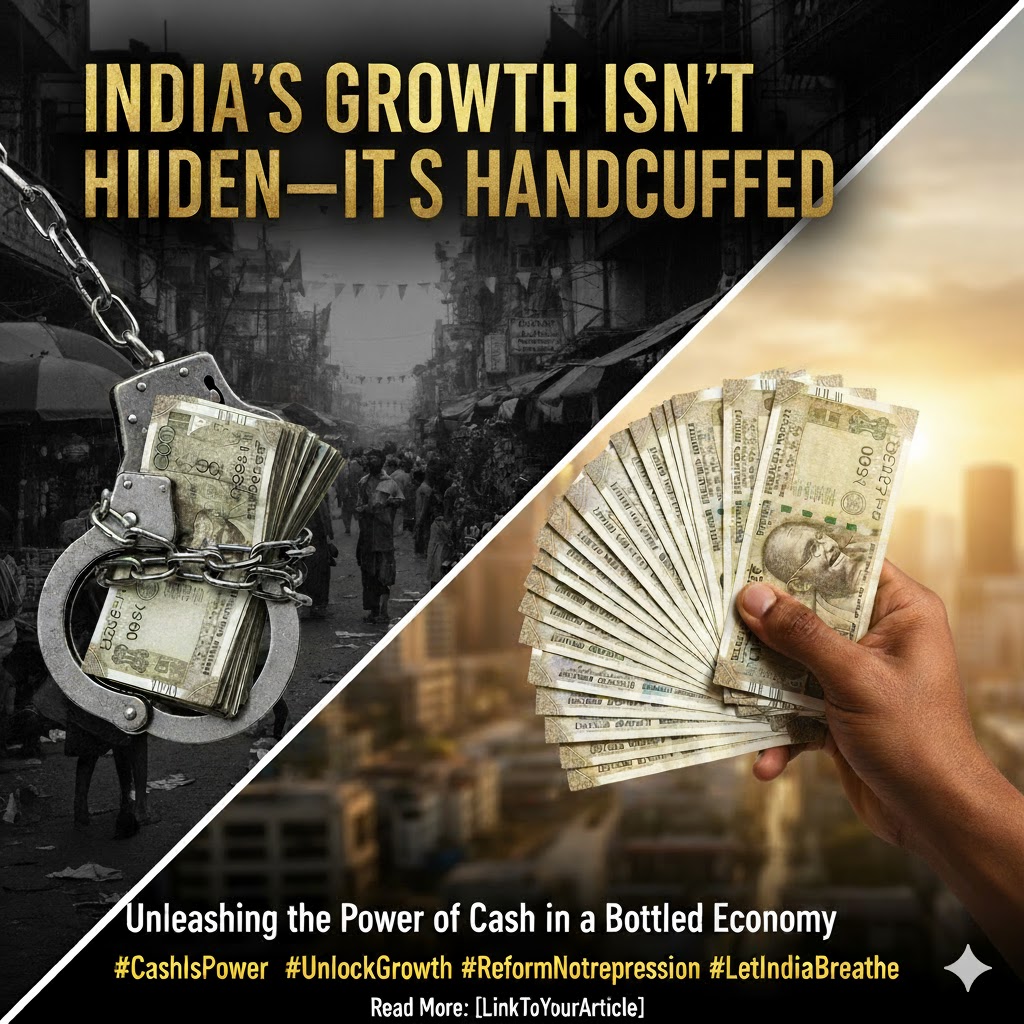
Unleashing the Power of Cash in a Bottled Economy
Abstract Fusion
India’s economic narrative is throttled by a fundamental paradox: the persistent, massive volume of Cash in Circulation (CIC) is treated as a liability, not an asset. This paper argues that growth is “handcuffed” by policies that constrain the free flow of cash—including legitimate idle funds and unaccounted capital (often termed ‘black money’). While the digital economy excels at micro-transactions, the lakh crore CIC and the informal sector demonstrate that cash remains the nation’s lifeblood. We propose a strategic shift from punitive control to pragmatic capitalization. By implementing innovative mechanisms like Cash Reintegration Bonds (CRBs), India can safely and transparently channel this dormant lakh crore into public infrastructure and social sectors. This is not leniency; it is economic sovereignty. Unleashing the power of cash transforms stagnant capital into sustainable investment, enabling India to achieve its true growth potential.
I. Introduction: The Unutilized Wealth Paradox
1.1. Cash: The Economy’s Backbone -The Growth Imperative
Cash is crucial for liquidity, inclusion, and economic stability in India. It underpins widespread economic participation, especially for the large unbanked population, supporting trust and continuity during digital disruptions. It ensures direct spending control and privacy—fundamental for a healthy, inclusive economy
India is chasing a multi-trillion-dollar economy target, a necessity for lifting millions out of poverty and cementing its place as a global power. Yet, this pursuit is throttled not by a lack of potential, but by a denial of available resources. The current resource gap—the chasm between public spending needs and formal tax collection—cannot be bridged by taxing the compliant few more heavily. The solution lies in mobilizing the vast capital that already exists but is currently unproductive.
1.2. The Bottleneck Is Policy, Not Potential
India’s parallel economy is estimated to be 20–30% of GDP, translating to ₹60–90 lakh crore in unaccounted liquidity. This is not a shadow—it’s a lifeline. Yet every rupee not digitized is treated as a threat. Every transaction not logged is presumed criminal.
Under the Black Money (Undisclosed Foreign Income and Assets) Act, 2015, the government raised ₹35,105 crore in tax demands—but recovered only ₹338 crore. The 2015 compliance window yielded ₹4,164 crore in foreign asset disclosures, proving that trust works better than terror.
Meanwhile, Indian-linked funds in Swiss banks rose to ₹37,600 crore in 2024, yet the government admits these figures include legitimate deposits and liabilities—not necessarily illicit wealth.
The Cash Conundrum
The narrative of “Digital India” is a spectacular success: UPI transactions now average over 15 billion monthly, crossing lakh crore in value. This surge has streamlined small, frequent transactions (Footnote 17). Yet, despite this digital push, the fundamental paradox remains: the absolute volume of Cash in Circulation (CIC) continues to climb, standing at a staggering lakh crore (approx. Footnote 9). This is the Cash Conundrum: two colossal economic realities—one digital, one physical—that must coexist. This unutilized capital, whether legitimate funds lying unproductive (idle capital) or unaccounted income (black money), represents India’s largest untapped national asset.
Now meet Pappy.
A small-time snack vendor, Pappy earns his living in hard cash—every samosa, every fritter, every chai sold adds to his modest pile. After years of saving, he dreams of buying a dwelling unit for his family. To deposit his cash, declare the amount—triggering a 30% tax liability. That tax wipes out his ability to buy. He drops the idea. His money stays locked in his home, unused. The economy loses a dream, a home, a future.
Multiply Pappy by millions. Across India, cash lies dormant in household safes. It is not criminal—it is trapped. And the nation pays the price.
1.3. Thesis Statement
This paper argues that effective, transparent, and innovative mechanisms to channel this unutilized cash flow are critical. We must implement strategic policies that move beyond punitive measures and enable the honest, productive reintegration of cash into the formal economy, boosting investment, formal GDP, and sustainable growth.
II. The Problem: Understanding Unaccounted and Idle Cash
2.1. Defining the Terms
The problem is twofold, yet often conflated under the pejorative term “black money.”
- Idle Capital: Legitimate funds lying unproductive and uninvested. This includes household savings hoarded in physical assets (like gold or unrented property) that are deliberately kept out of bank accounts due to lack of trust or a desire for anonymity.
- Black Money: Funds earned through illegal activities or, more commonly, legal income deliberately concealed from tax authorities through evasion. This money requires mechanisms to be parked, often distorting asset markets.
2.2. The Economic Drag (Defining the “Bottled Economy”)
The enduring necessity of cash highlights the scale of the economy that policy treats as a liability. The Cash-to-GDP Ratio stands high at in FY 2025, proving cash still underpins a significant portion of the nation’s total economic activity (Footnote 9).
This is the “Bottled Economy”:
- The Informal Sector contributes approximately to the total GDP (Footnote 10), operating almost entirely on a cash basis. This massive sector, which includes laborers, small vendors, and micro-manufacturers, is where cash acts as the primary, zero-transaction-cost lubricant.
- The persistence of cash in consumption confirms this necessity: approximately of India’s consumer expenditure is still conducted in cash (Footnote 11).
This cash dependence creates three fundamental economic drags: Loss of Tax Revenue (widening the fiscal deficit), Creation of a Parallel Economy (distorting official data), and fueling Inflationary Pressures and Inequality (as unaccounted wealth flows into speculative assets like real estate).
2.3. Sources of Generation: The Power of High-Value Cash
The dominance of high-denomination notes reveals that cash is used not just for small daily needs, but for the most critical value transfers. The notes accounted for of the total value of banknotes in circulation in FY 2025 (Footnote 12), up from previous years. This concentration demonstrates its role in large-value, untraceable transactions that keep the wheels of the informal economy—and the evasion-prone sectors—turning.
Key sectors prone to generating and parking this high-value cash include:
- Real Estate: of property transactions involve cash through underreporting, making it the primary conduit for parking large sums (Footnote 13).
- Complex Financial Transactions: Mis-invoicing, trade-based money laundering, and cash payments to avoid capital gains.
- Corruption and Political Funding: Anonymous funding mechanisms rely heavily on physical cash.
III. The Opportunity: Unleashing the Power of Cash
3.1. Quantification of Potential
India’s parallel economy is estimated to be of GDP—translating to lakh crore in unaccounted liquidity (Footnote 1). Furthermore, an estimated trillion is held as idle domestic cash and valuables (Footnote 14). This trapped capital, if mobilized, represents the largest single source of potential non-debt-creating public funding.
3.2. From Liability to Asset
Mobilizing this money can fund:
- Infrastructure: Providing immediate, non-inflationary capital for public works, high-speed connectivity, and sustainable energy projects.
- Social Sector: Directing funds toward immediate needs in education, healthcare, and poverty alleviation programs that often suffer from fiscal shortfalls.
- Formal Lending: Boosting the capital available for Micro, Small, and Medium Enterprises (MSMEs) and start-ups, which are the primary employers in the country (Footnote 15).
3.3. The Virtuous Cycle
Integrating these funds creates a powerful virtuous cycle: increased formal investment leads to job creation, higher reported incomes, and subsequently, a higher tax base and sustainable growth, fundamentally addressing the problem of evasion rather than simply punishing it.
IV. Policy Frameworks for Mobilization
4.1. Formalizing Idle Capital
The simplest win is integrating legitimate savings.
- Incentivizing Flow from Physical Assets: Introduce schemes to encourage the transparent sale of physical assets (gold, unrented property) and reinvestment into financial markets, offering tax breaks on the capital gain if funds are directed into government-approved instruments.
- Unlocking Stalled Assets: Policies to expedite judicial and regulatory processes to liquidate or monetize stalled projects, releasing locked capital back into the lending system.
4.2. Strategy for Black Money Conversion (The “Unleash” Policy)
Past punitive measures have failed, as evidenced by the low yield on the Black Money Act, 2015, which recovered only crore against demands of crore (Footnote 2). We must prioritize productive investment over punitive measures.
- Cash Reintegration Bonds (CRBs): Introduce a low, one-time reintegration tax (e.g., ) on declared cash, mandating the balance be invested in special, long-tenure, low-interest bonds. These funds must be ring-fenced for national infrastructure projects, ensuring the money is channeled into nation-building, not consumption.
- Transparent Digitalization: While UPI is dominant (with its share in P2M transaction volume), policies should focus on making digital infrastructure reliable and low-cost in the informal sector, not penalizing cash (Footnote 16).
4.3. Strengthening the Deterrence
Simultaneously, future evasion must be made structurally difficult:
- Tax Simplification: Simplify the complex tax laws that inadvertently create incentives for evasion.
- Robust Enforcement: Implement strong, targeted enforcement measures (e.g., Anti-Benami laws) against the future generation of black money, making the cost of new evasion outweigh the gains.
V. Case Studies and Global Examples
5.1. Lessons from Past Initiatives
Past initiatives like the demonetization of 2016 primarily targeted the stock of cash but failed to curtail the flow of new unaccounted income. The subsequent increase in CIC proves that without structural reforms, cash will naturally replenish. Conversely, the 2015 Compliance Window for foreign assets yielded crore in disclosures, proving that trust-based, structured amnesty works better than terror (Footnote 3).
5.2. International Models
- Italy & Greece: These nations operate with large underground economies (estimated at of GDP) which stabilize and sustain millions of informal jobs (Footnote 8). They acknowledge this reality, focusing policy on gradual integration rather than outright prohibition.
- Switzerland: Its cooperation under the Automatic Exchange of Information (AEOI) framework shows that while secrecy is gone, India’s focus must now shift from chasing data to developing a secure domestic environment where capital feels safe to return and invest.
VI. Conclusion: A Call for Comprehensive Reform
Let the Cash Roar, Let the Nation Rise
This is not a plea for leniency; it is a demand for liberation.
India’s cash economy is not a threat—it is a sleeping giant. While digital transactions are powerful, the physical lakh crore CIC and the informal GDP demonstrate that cash remains the lifeblood of the nation’s productive majority. Every rupee trapped by fear, every transaction aborted by regulation, is a lost opportunity for growth, dignity, and national resurgence.
Locked in household safes, company lockers, and the hands of millions of small vendors, it waits—not to be punished, but to be unleashed. Every rupee trapped by fear, every transaction aborted by regulation, is a lost opportunity for growth, dignity, and national resurgence.
Let the cash roar.
Let it build homes, fund startups, pay wages, and fuel dreams.
Let it move freely, without restraint or harness.
Let the economy flourish—not in spreadsheets, but in streets, stalls, and stories.
This is not softness—it is sovereignty.
This is not evasion—it is evolution.
This is not black money—it is latent sparkle.
India doesn’t need more surveillance. It needs more trust.
It doesn’t need more punishment. It needs reintegration.
It doesn’t need to chase shadows. It needs to light the fire.
Unchain the cash. Unleash the growth. Let India breathe.
Footnotes
- Estimates on the size of India’s parallel economy vary significantly, with figures from various committees and studies ranging between and of GDP.
- Data on the demands levied ( crore) and subsequent recovery ( crore) under the Black Money (Undisclosed Foreign Income and Assets) and Imposition of Tax Act, 2015, were reported by the Ministry of Finance in response to questions in the Rajya Sabha/Parliament, covering the period up to March 31, 2025.
- Figures for the one-time compliance window disclosures and collections were officially reported by the Ministry of Finance following the conclusion of the scheme in 2015.
- The figure of crore represents the total liabilities of Swiss banks towards Indian clients as reported by the Swiss National Bank (SNB) for 2024.
- This estimate is a widely circulated figure representing the quantum of domestic black money across various reports and is often cited in discussions following events like demonetization.
- Estimates from bodies like the National Institute of Public Finance and Policy (NIPFP) and other studies commissioned by the government have consistently placed the involvement of black money in real estate transactions between and .
- Data from the Ministry of MSME confirms the immense scale of the sector.
- International Monetary Fund (IMF) and other economic studies have quantified the shadow economies of countries like Italy and Greece.
- Reserve Bank of India (RBI). (Source: RBI Annual Report, May 2025: Data on Cash in Circulation (CIC) and Cash-to-GDP Ratio).
- Ministry of Statistics and Programme Implementation (MoSPI). (Source: MoSPI Official Data/Reports, Jan 2025: Informal Sector’s Contribution to GDP).
- RBI Data / Worldline. (Source: Worldline India Digital Payments Report, June 2025: Share of Cash in Consumer Expenditure).
- Reserve Bank of India (RBI). (Source: RBI Annual Report, May 2025: Data on Dominant Banknote Denomination by value).
- Estimates from bodies like the National Institute of Public Finance and Policy (NIPFP) and other studies commissioned by the government have consistently placed the involvement of black money in real estate transactions between and .
- This estimate is a widely circulated figure representing the quantum of domestic black money across various reports and is often cited in discussions following events like demonetization.
- Data from the Ministry of MSME confirms the immense scale of the sector.
- Reserve Bank of India (RBI). (Source: RBI Report, October 2024: Digital Payments Share in P2M Transactions).
- Reserve Bank of India (RBI). (Source: RBI Report, September 2025: UPI Monthly Transaction Volume and Value).
Reference List
- Ministry of Finance, Government of India. (Official statement/Parliamentary Question on Black Money (Undisclosed Foreign Income and Assets) and Imposition of Tax Act, 2015, data up to March 31, 2025).
- Ministry of Finance, Government of India. (Press Information Bureau (PIB) releases regarding the 2015 Compliance Window under the Black Money Act).
- Swiss National Bank (SNB). (Annual Banking Statistics on Liabilities to Clients from various countries, including India, 2024).
- National Institute of Public Finance and Policy (NIPFP). (Various reports and working papers on the estimation of black money in India, focusing on the Real Estate sector).
- Ministry of Micro, Small & Medium Enterprises (MSME), Government of India. (Annual Report/Data on the number of MSMEs in the country).
- Economic Research Papers/Studies. (Multiple academic and institutional papers on the size of the shadow/parallel economy in India and in comparable global economies).
- Reserve Bank of India (RBI). (RBI Annual Report, May 2025).
- RBI Data / Worldline. (Worldline India Digital Payments Report, June 2025).
- Ministry of Statistics and Programme Implementation (MoSPI). (Official Data/Reports, Jan 2025).
- Reserve Bank of India (RBI). (RBI Report, September 2025).
- Reserve Bank of India (RBI). (RBI Report, October 2024).
#CashPower #EconomicGrowth #FinancialInclusion #ShadowEconomy #CapitalMobilization #MoneyVelocity #FiscalPolicy #UnleashGrowth #DigitalEconomy #ReadyCapital
Satpal Singh Johar
Email:
Cell Number :+919871286514


 pointblank0 By Satpal Singh
Leave a comment